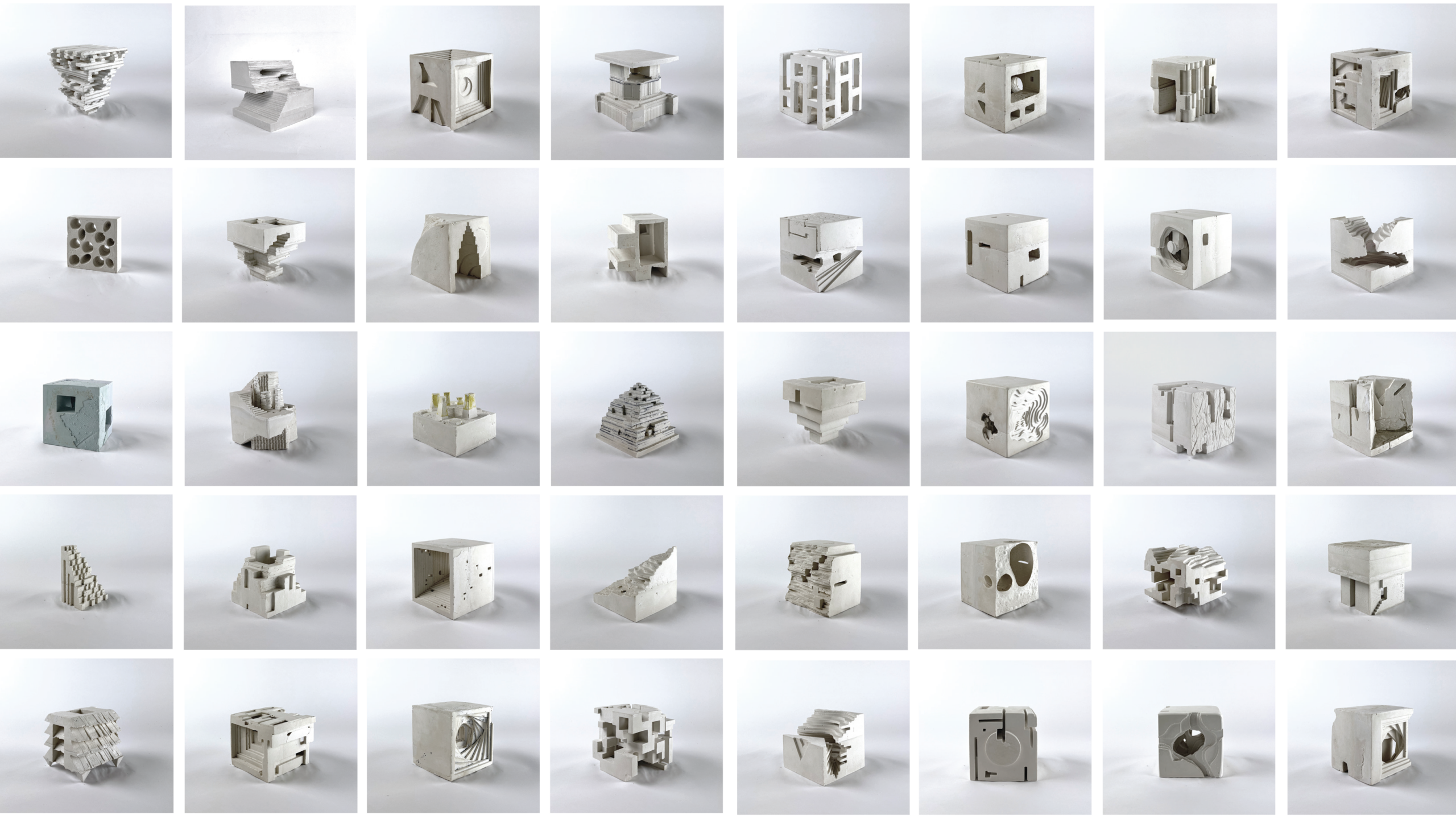
Formstudy – Academy of Architecture Amsterdam – 2022
This exercise aims to highlight the interdisciplinary aspects of work within the fields of architecture, landscape architecture and urbanism. Inspiration can come from anywhere and are often drawn from other creative environments such as film, theatre, photography, fine art, choreography, literature and design. Modern architecture, whether it’s a structure, a landscape or an urban design, often starts with a set of technical and functional requirements based on a conventional understanding of how a user might engage with the space. More often than not there is a dominance in our culture to value what we see over other senses and so in design there is naturally a tendency to rely on pictorial influences that ultimately produce spaces that mainly engage us visually. Were we instead to engage the user’s multiple senses we might invite a wider human experience of a given space. To explore this more complex set of values that a space could offer, this year’s exercise we will use sound as the key source of inspiration.
More specifically two pieces of music by composer Jonny Greenwood. He may not be a spatial designer, but one could argue that his unique working process and intricate arrangements has similarities with the qualities and methods required to produce innovative spaces. Examples are his evocative soundtracks for the films of directors such as Paul Thomas Anderson and Jane Campion. Jonny Greenwood perhaps best known for being the lead guitarist of the band Radiohead, who had their first success in 1992 and have sold over 30 million albums. From a young age he observed elements of natural sounds and conventional music composition. Later he would incorporates influences of different styles of music, like rock, jazz and classical music into his compositions , often along with unconventional and/or self-made instruments. The composition and performance of a piece of music have many similarities with aspects of spatial design, in the way we also often need to integrate disparate technical, functional and creative aspects, into a complete space.
Play Time Hole
The soundtrack to the The Master captures the conflicting notions of safety, prosperity, paranoia and discord prevalent during and after WW2. On Time Hole this is reflected in the layers of mysterious woodwinds that at first appear to be briefly in harmony, only to drift apart and become separate entities. Added to this are the subtle cries of seagulls that seem to at once compliment the sounds of the instruments and perhaps hint at the inspiration for the use of the woodwinds. Greenwood’s soundtrack not only heightens the emotional qualities of the narrative but takes on an unsettling language of its own.
Play 25 Years
More recently Jonny Greenwood scored Campion’s The Power of the Dog; a film that deals with themes of love, grief, resentment, jealousy, masculinity, and sexuality. The track 25 Years is perhaps initially in sharp contrast to Time Hole, appearing to have a more conventional composition, but this quickly gives way to the discord of the strings that accompany the guitar strumming that opens the track. Inspired by the alien landscape of the Montana setting and the conflict of the different instruments Greenwood creates a haunting soundtrack that never seem to directly mirror the emotions of the characters on screen as if to show how at odds they are with each other.